The Next Dark Age
We're in it Now
Halloween Candy is Serious Business
MSN ran an article on the Best and Worst Halloween candy. The short version is that it all has gobs of sugar, so we should avoid anything that has fat. Which means chocolate and peanuts.
Screw that.
And this was even funnier:
“When giving out treats to kids, it’s better to stick to healthier items like sugar-free gum, popcorn, pretzel packs and raisin boxes, Mangieri said. For example, a 1-ounce (28-gram) serving of pretzels has 110 calories, one gram of fat and less than one gram of sugar. And a quarter of a cup of raisins has 130 calories, no fat and 29 grams of sugar, in addition to fiber, protein, potassium, iron and calcium.”
That is called the recipe for getting your house TP’d. (Although, assuming there is enough chocolate in your bag already, the pretzels might be o.k).
I haven’t even picked up my Halloween candy yet. But I can assure you, it will not involve raisins.

The War, by Ken Burns
While I have something of a WWII theme going on this year, I can honestly say that I would watch just about anything that Ken Burns decides to produce.
Because the subject matter is so broad, Burns used an interesting storytelling device: he picked four U.S. towns, one in each part of the country, and wrote about the War from their points of view. There was plenty of video footage, and lots of photographs, as well as voice-overs of correspondence and articles – very similar to his documentary on The Civil War. The difference was that instead of interviewing historians, Burns recorded interviews with survivors – soldiers and their families.
My favorite story was one that I hadn’t heard a thing about before. A young girl had been living with her family in the Philippines when the War broke out and they were sent to an internment camp. Sascha kept a diary, of which exerpts were read, and she was interviewed in the present day (2006?).
I was also drawn in by the interviews with Senator Inouye of Hawaii. Because he was the son of Japanese immigrants, Inouye was banned from enlisting until ..1943? He was a platoon leader in Italy.
Things I learned:
- 240 days straight is about the maximum that any human being can be in combat without going insane.
- We lost an awful lot of planes crash landing onto air craft carriers.
- We bombed the hell out of Tokyo before dropping the atomic bomb on Hiroshima.
- (This was more an “I’d forgotten”). Stalin didn’t declare war on Japan until after we had dropped The Bomb on Hiroshima.
- Army medics were paid less than the average soldier – $10 a month.
Last Christmas, I gifted my grandfather with Burns’ documentary on the National Parks
Overexposed
Weekend Assignment # 341: Overexposed
Some things (or people) explode into the culture, are really big for a while and then overstay their welcome. Who or what are you really tired of seeing, hearing or reading about these days?
Extra Credit: What discarded bit of pop culture do you remember fondly?
Anyone who was ever made “famous” by a reality TV show.
I am pointing in particular to The Hills and the Housewives shows. I have not watched any of them, but I have seen enough commercials. I will also throw in Paris Hilton, Omarosa, and whatever show “The Situation” is on.
I’ve said before: my feeling is these shows generally reward bad behavior and I refuse to participate by watching. And it seems that I am missing lots of pop culture references these days, which makes me even more resentful.
They make me feel old.
It is my opinion that Reality TV peaked when Puck was kicked out of the San Francisco house. And it jumped the shark with the “Rats and Snakes” (which I did watch).
I miss the old scripted soap operas: Dallas and Dynasty. Knots Landing and Falcon Crest. They were over-the-top dramatic, they had people to root for and those that you loved to hate. And they were not (even remotely or through skillful editing) real.

Plug from the Trib
My grandfather called to point me to this article about Glenview’s Library in the Chicago Tribune. Most of it, I had heard before. But not this:
“Demand for library services at this suburban locale is continually increasing with new card registrations up 56 percent in 2009.”
Function of the economy, or anticipation of the new building?

BTT – Foreign
Name a book (or books) from a country other than your own that you love. Or aren’t there any?
There are a thousand. But off the top of my head:
My favorite book from another country is A Christmas Carol
One Day in the Life of Ivan Denisovitch , by Alexander Solzhenitsyn, was a “One Book, One Chicago” pick and can be blamed for my gravitating back to the Russian writers. It is a short novel of one man’s day in the gulag and it does a lot with the themes of survival and integrity.
The Three Musketeers


But if I may make a plug for my old professor, Arnost Lustig, his Lovely Green Eyes 
United Airlines Loves Me and Wants Me to Be Happy
Yeah, yeah.
It has become obvious that the way to get the best deals and the best service from the airlines is to pick one and use it exclusively. So a colleague asked me why I fly United. “Hometown airline” is the easy answer. It started when I was in college, because United had hourly flights between O’Hare and National Airport. It still does – almost. One complaint that I regularly hear about United is the lost luggage phenomenon. I can’t remember the last time United mishandled my luggage and I theorize that because the vast majority of my travel involves direct flights, there is a significantly reduced risk of my bag going to the wrong place. So unless there is a really good reason, I fly United.
This week, I stayed in DC for three nights, so I checked a bag. I hadn’t done that in awhile, and when I reached baggage claim at Reagan, I was all eye-rolling about how long it would take for the bags to come out. Then I saw it:
My bag. In a little row with some other bags. It was already there. My bag had gotten on an earlier flight and was waiting for me. Score.
By this afternoon, when I flew home, I was cranky again because checking a bag meant that I wouldn’t be able to fly standby (if I was willing to shell out that $50, I mean). I was early to the airport because I had shared a cab with a colleague who flys American.
Would you believe my bag was waiting for me when I arrived back at O’Hare? Double score.
So thank you, UAL, for making my travel days a bit less sucky.
Nothing New Here
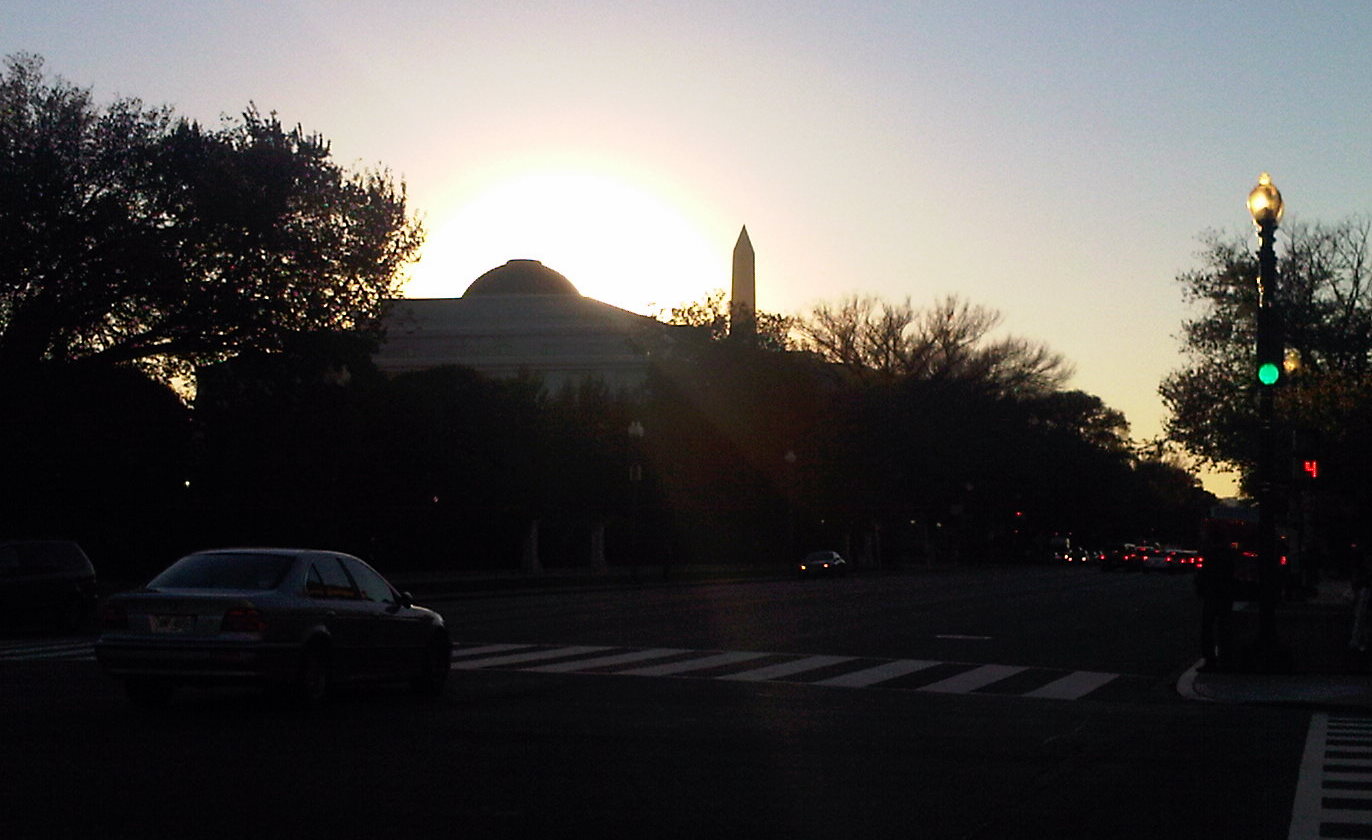
That dome is the Natural History Museum. I’ve only been there once or twice since graduation, but it is where they keep the Hope Diamond. It is very pretty, but seriously. Don’t waste five minutes of a trip to Washington standing in line to see it.
The Walls Around the Monuments
I left the office, checked in at the hotel, and set off to make my pilgrimage to President Lincoln. I had it in mind to try to see something that I hadn’t seen before. That didn’t work. It was a rather gray day and the first thing I saw is that the sun was shining on nothing but the Capitol:

It is my understanding that everyone has gone home until after the election. Whatever. So I turned around and kept walking.
These days, whenever I approach the Washington Monument, I am irritated. You wouldn’t know it if you hadn’t been here before 9/11, but there are several new pathways and short walls and cement barriers so one is obliged to walk halfway around the globe to get to the other end of the Mall:

Back in my day, we hiked up the hill to those flags and over the top. You could touch the Monument as you went by without feeling like a criminal. To be fair, there isn’t exactly anyone there telling the tourists to go around, (in fact, you can see a little kid playing there in the middleand the horse carrying the park ranger seemed to be there for the children to pet) but it is clearly discouraging. So I walked around.
As these paths and barriers were going up, I worried about this one tree. It seems rather out of place, which is why I always liked it.

I have taken several good naps under this tree, but don’t tell my mother. Anyway, I was afraid that someone would cut it down to make the world safer for democracy. But it seems to have survived.
Then I went back to my regularly scheduled pilgrimage.
With God as My Witness, I Am Going to Finish This Book
I do not understand why I cannot finish The Brothers Karamazov. It is not a bad book. There is one noble creature to root for. There is intrigue. There is danger. There will be a mystery if I could just bloody get to it.
I am packing to go to Washington tomorrow and I looked at the book I just started and I looked at my big, fat copy of Brothers. I must finish it.
People of the Book was supposed to be my lunchtime book. But it was so good that I brought it upstairs to read this weekend. Last night, I dropped The Zookeepers Wife into my bag to carry around. Trade paperback, about the right size. This could go on forever.
Maybe I’m just going to not have a “carrying around” book.
That’s not going to work.
Oh, hell.
I just downloaded The Brothers Karamazov to my Kindle. I just paid for a book twice to make myself finish my “summer epic”.
This had better work.
People of the Book, by Geraldine Brooks
People of the Book, is the most recent novel of Geraldine Brooks. I will read any damn thing she writes.
“The Book” is the Sarajevo Haggadah, a centuries old book precious not just for its age and craftmanship, but for the fact that it is illustrated, which was a serious breach of the rules back in the day. The premise is that the Sarajevo Haggadah was rescued from its museum home during the Bosnian War and in 1996, the museum is preparing to put it back on display. An Australian conservationist has been asked to study it, repair what should be repaired and write instructions on how best to keep it for the future.
While it is not at all the point of the book, Hanna, the expert in question, makes a distinction between “restoration” and “conservation”. She maintains that to attempt to restore the book to its original state would be to lose some of its history forever. So the book keeps its crappy 19th century binding, for example, because that reatains some of its authentic…whatever.
The novel shifts from Hanna’s work (and personal life) in 1996 and several historical points in the history of the Haggadah. For example, the first thing Hanna finds is the piece of an insect’s wing. The next chapter is Sarajevo, 1940, telling the story of the Jewish girl who finds herself smuggled out of town with the Book (by the Muslim curator of the museum), before the Nazis catch either of them. With each shift, the history goes further back and it is totally fascinating.
The last shift made me a bit cranky, but it rather brought the plot back full circle, and led to the discovery that SPOILERS the original artist was a Muslim woman. So…forgiven.
Brooks has a bit too much fun with the Inquisition for my taste. I just don’t do that Spanish Inquisition. And when a “history” chapter ended, I was always left with a “But. What happened next?” Which ticked me off, but was pretty realistic. I also appreciated the ongoing theme of times and places when Jews, Christians and Muslims lived together peacefully. And when they didn’t. Finally, Brooks kindly gives us an Afterword, noting the history that inspired her, the research that she did, and the stuff she totally made up.
I loved this book. I just regret that my copy is a beat up trade paperback.

 The Next Dark Age