The Next Dark Age
We're in it Now
Dr. Zhivago
 The other day, Marilyn asked if I had seen any movies lately.
No. I don’t enjoy the movie theater experience anymore, and I am generally listening to an audio book when I am home.
Then I thought, “I am turning into one of those people.” Not as bad as those who brag about not having a television, but still. So I grabbed the copy of Dr. Zhivago that I ordered after finishing the book a couple of months ago. Not exactly cramming for the Oscars, but it counts.
As an epic book-to-film, it was excellent. My primary criticism is that the film did not do well by Strelnikov. In particular, it cut a scene between him and Zhivago that did a lot to make Strelnikov more three-dimensional.
What the film did extremely well (what Omar Sharif did extremely well, actually) was make me believe in Zhivago the Poet as opposed to Zhivago the Doctor. He also made me believe that he loved his wife and he loved Lara. Although the affair in the Urals was so sharply edited that if I hadn’t read the novel I might not have bought it.
Rod Steiger totally hit the right notes as the opportunistic bastard who has a flash of conscience every once in awhile. Julie Christie was more pouty and less serene than I had imagined, but it was fine.
I am glad I took the time. And will now go back to my regularly scheduled book.
Eats, Shoots and Leaves: The Zero Tolerance Approach to Punctuation, by Lynne Truss
 Book 11
I am sorry to tell you that I am one of those people that judge people by the way they use “to, two and too” and “there, their and they’re”. That is not to say that my grammar is perfect. My mother will tell you that my editing skills suck. Regular readers of this blog may understand why. But I am interested in knowing the rules, even if they change all the damn time.
Side note: My favorite example is how to highlight the title of a book. I seem to remember being taught, in grade school, that book titles are to be underlined and the titles of newspaper or magazine articles are to be in quotations. My last boss, Dave, majored in journalism. He is the first person that told me book titles should be italicized. This books notes that italics are the print equivalent of underlining. Makes sense. I suppose.
Truss does some home work on the rules and the cranky old men that enforce them. She takes a look at the origins and the evolution. She even delves into texting and emoticons (ugh).
Another Side Note: I was just going to write, “she even gets into texting”, but I can still here the voice of my 8th grade teacher in my head. Mrs. Trahanas used to say, “Never use the word ‘get’ in your writing. It is a lazy, undescriptive word. There is always an alternative.” Damn English teachers. (Sometimes I ignore her, though.)
I realized, about halfway through the audio, that the audio book was from the radio series, rather than a reading from the actual text. But a lot of it is the same, so I am counting this as a read book. But before I go back and flip through it again, here are some things I learner:
- Women use exclamation points more than men do. This makes sense, I suppose, but I never thought about it before.
- Green grocers are terrible with punctuation. This was a half-joking observation. Apparently, some people think that if you do not use an apostrophe, the word bananas might be pronounced ba-nan-ass. Listening to this in the audio, I wondered if this was a British problem.
- The lawyers don’t seem to be able to evolve. Apparently, their templates just can’t handle it. Actually, I knew this from their continued insistence on Latin phraseology.
- The British like to blame every grammatical transgression in the English language on the Americans. What. Ever. (See how I did that?)
On Chesil Beach, by Ian McEwan
 Book 10
I read recently that McEwan is the master of the defining moment – meaning a point in time after which absolutely nothing is the same. Point of no return.
On Chesil Beach is the story of a newly wed couple on their wedding night. It is 1962 and we are told right off the bat that Edward and Florence are both virgins. As the story advances and bounces in flashback, we come to understand that Florence was sexually abused by her father.
SPOILER WARNING
It is no surprise that the Big Moment is a disaster. Florence runs off and Edward follows her. The ensuing conversation is the defining moment. Can these two people that, presumably, love each other have the difficult conversation and begin to reconcile the issues?
SERIOUS SPOILER WARNING
In a word, no. Both are too hurt, too vulnerable and too angry to reach out effectively. What McEwan does brilliantly is remind the reader that people say incredibly stupid and hurtful things when they are feeling defensive. So as to reject another before being rejected.
I spent most of the novel disliking both characters. But the moral of the story pulled it all together in a way that really does make McEwan the Master of the Defining Moment.
The Good Earth, by Pearl S. Buck
 Book 9
I picked up this book because it is on Miss Busy’s list of all-time favorites. And the audiobook was at the Library.
Really good stuff.
The story opens with Wang Lung’s wedding day. The bride is a slave from the house of the local rich guy. She is a total gem named Olan. They work together quietly and slowly begin to grow a small farm and family while caring for his father.
A few years in, a drought strikes and everyone in the countryside goes hungry. The family leaves the farm and heads to the city to find what work and food they can. They depart after the birth of a fourth child, dead on arrival. We are led to believe that Olan killed her rather than have one more child to feed. As it is, the hunger has stunted the development of the third child and she is left permanently (helplessly) disabled.
This stretch, relatively early in novel, reminded me of The Grapes of Wrath and I was bracing myself for even worse badness. It isn’t pretty, but they muddled through and made off with some cash when the city’s local mansion is looted. They head home to better times.
Work hard. Spend little. Grow the farm – even hiring labor. The sons go to school. There is also the continuing menace of his uncle and family – idle and manipulative to the point of evil.
Many years go by before the next natural disaster..bad flooding. But this time, Wang Lung has plenty of money and the family is in no mortal danger. But Wang Lung starts to frequent the tea houses, picks up a mistress and spends money like water. He is a total ass to his long-suffering wife and I found it hard to forgive him. The point, though, was that Wang Lung was becoming one of the “lords” that he despised and envied in his youth. He had the good grace to feel ashamed. Occasionally.
Times passes and the children grow. Olan, who has harbored an illness in silence for some time, dies. The sons are educated, but don’t appreciate the land. The youngest, the only one who ever worked it, runs off to join the army. I was reminded of the book, The Millionaire Next Door, which theorized that most fortunes only last three generations because each one gets further from the original business that created the fortune.
I spent the last chapters of the book wondering if Wang Lung would live to see the Revolution. And whether his fortune would last long enough for it to kill them all.
Overall, the theme of work = good and idleness = bad was pretty good. Also, the questions of what people will accept and what they will fight for. The shadow of Revolution hanging over the house kept the tension pretty interesting.
I am very glad I read this.
Short Week in Washington
Just got back to town. Let’s start with “things I forgot”:
- Shampoo, conditioner, shower gel, face cleanser. Because I left them in the shower in Honolulu. This led me to spend $20 at the new Lush store in Pentagon City, and I was still using hotel shampoo.
- Cash. I had about $20 on me, and I made it work without shelling out an ATM fee. Ha.
- Plug for the iPhone, so I was required to charge it through my computer. Unacceptable. I will have to get another plug and keep it in my suitcase.
So. The National Federation of the Blind was having a conference in the hotel this time. I have never seen so many labrador retrievers in my life. It was awesome. Their handlers took them to do their business on a grassy patch across the street which was an interesting sight at 7:30 in the morning. 18 dogs trying to pee in the same 8 by 20 piece of urban landscape.
Yes, they all cleaned up the mess.
I have always been impressed by the (seeming) ease with which the blind can navigate the world. Multiply that by about a thousand for navigating a strange city. Stefphanie and I were talking about over lunch at McD’s – first Shamrock Shake of the season – and as I was marveling over the blind successfully hailing a taxi, Stef was noted a blind couple finding an empty table during the lunch rush at McDonald’s. I imagine that many of these folks have some small range of vision, as opposed to total darkness, but still.
In other news, I am sorry to say the weather failed me and I didn’t get out to see Dr. King’s memorial. Next time, I am sure.
Today, I am hating on those that drag their rolling luggage onto the airplane after the gate agent tells them to gate check it. You people waste my time and worse than that, someone is going to get hurt.
And finally, I am pretty sure I saw Lisa Madigan boarding my flight. Which would be the second time I have seen her on the ORD-DCA-ORD commuter flights. Assuming it was her, I would like to report that she was not dragging a carry on with her and not yammering on a cell phone. Which pretty much means I will be voting for her in the next election.

Failed Foster
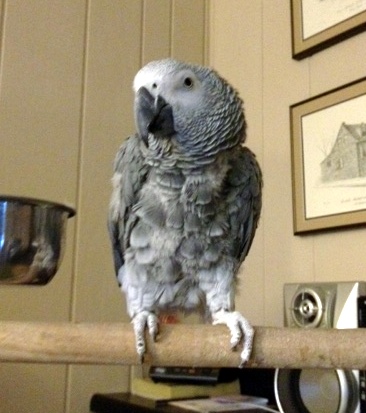
Sigmund the African Grey came to the Refuge with Vito, another Grey that is bigger, prettier (read as: fully feathered) and more sociable. Vito got a lot of attention and we knew that he would be adopted relatively quickly. He was.
I first brought Sigmund home.. this pic was dated May 15, 2010:
Look at those feathers. Chewed off flight feathers and little more than fuzz on his chest. But he stepped up – as long as I offered my left hand. And he was a good eater. And he was not bothered by the other animals in the house (then Shadow the Dog and Spooky the Cat in addition to Kiwi the Grey).
For about a year, I kept him most of the time, returning him to the Refuge every once in awhile when I was travelling heavily. Or when a potential adopter was coming by. Or when one room or another in my house was being painted. Each time he was back at the Refuge, he chewed a bit harder on his feathers. I determined that he just needed to be in a quiet home to feel comfortable enough to leave the feathers alone. The progress was gradual.
First, he started shredding the paper that lined his cage. On the days he did that, he left his feathers alone. Then he started to shred his toys, instead of feathers. Eventually, he looked like this:

The picture is dated April, 2011. No one at the Refuge could believe it. The dirty little secret is that Sigmund had trained me. He woke up with the sun and expected his breakfast. After work was play time and he expected to be let out. He has a scream that you wouldn’t believe belongs to a grey. But I did all of that stuff so that he left the feathers alone.
Around this time, I understood that he had been in my house longer than any foster before (Manu was around 10 months when he found his forever home) and I’d better get serious about finding him a permanent situation. And shortly after that, Shadow the Dog died and we were in the market for a puppy.
When Gibbs came home, another volunteer agreed to take Sigmund for a bit just to see how he would do in another quiet home. It lasted two or three days before she couldn’t stand watching the feathers drop to the floor. She brought him back to me.
By then Gibbs had been there for a week or so. His puppiness was a bit much for Sigmund. Feathers were everywhere. In a panic, I spoke to Rich, the Refuge director. He said, “You can’t get upset about this. He is going to have to learn to adapt.” And also, “It is clear that he has chosen you.”
Crap.
Next we had my mother’s health crisis. I was afraid to move Sigmund and afraid to commit to adopting him. But he and Gibbs worked it out. Gibbs doesn’t bother Sigmund when he is running around on the floor. (He only gets upset when Kiwi goes airborne. Shadow was the same way.) Then we got to the holidays and Big Work Meeting. But I pretty well knew that he was staying. Sigmund decided.
Last week, I signed the adoption papers. This is how he looks now. The good news is that since he chews, rather than plucks, his feathers there is always hope that they will all grow back. Rich said I shouldn’t hold my breath. Here is Sigmund now:
The Penelopiad, by Margaret Atwood
 Book 8
The Penelopiad is part of a series of books where “some of the world’s finest writers” retell the old myths. Atwood chose Penelope and Odysseus.
Atwood has a serious problem with the end of the Odyssey, where Penelope’s 12 maids were hung. So she tells the tale of Penelope’s life – in the first person from the Underworld – interspersed with the “chorus” of the maids. It was positively Shakespearean.
Also, in this tale, Penelope can’t freakin’ stand her cousin, Helen. Which was awesome. However, Atwood paints Helen as far more lustful, slithery and vain than I had considered. I always thought her merely dumb. Really dumb. And vain.
Inasmuch as I always dig the alternate point of view, and I have always rather liked Penelope, I was very happy with this book.
The Tipping Point, by Malcolm Gladwell
 Book 7
I seem be the last person on Earth to read this book. It is pretty good if you like the sociological study books. Gladwell does his homework on what he calls, “social epidemics”. I would call it what makes stuff go viral.
He talks about three things: the people that spread the word, the things that make a message stick and the context of the message.
My favorite story was about the creators or Sesame Street, and how they made learning stick with young children by keeping their attention. And then. 30+ years later the creators of Blues Clues did it even better. They statistically proved that kids watching Blues Clues retained more information.
Gladwell also did an interesting experiment. He took random groups and read 250 random last names out of a phone book and has the people count how many people they knew with those names. If you know ten people of the same name, even if they are related, you count them all. The ranges were pretty big and the people that had numbers over 100 were serious networkers. The people that enjoy networking. Then he talked about how those people spread the word on lots of stuff.
Gladwell writes a good book – and he read the audio book. But I need some fiction now.
The Talent Code, by Daniel Coyle

Book 6
My friend Jamie picked this for our book club and I thought it was good enough to recommend to my boss for our next department read.
Coyle spent a whole bunch of time studying what he called “hotbeds of talent”. Random places that started churning out the best-of-the-best in one field or another and tried to figure out how it happened. South Korea suddenly dominating the LPGA, charter schools in inner cities sending 100% of the students to college, that kind of thing.
Coyle’s theory is that almost none of it is what we would call Natural Born Talent and almost all of it is practice. He starts by defining “deep practice”, when you are in the zone. Of course, this requires motivation which begins with “ignition”. Finally there is Master Coaching.
There are plenty of great stories, although it is admittedly sports-heavy. There is also a bunch on the neuroscience which I had to slog through, but if you can get past that it is really very good.
 The Next Dark Age