The Next Dark Age
We're in it Now
Thoughts on the Declaration


At the Refuge – Meeting the Public
When we manage to find the right event at the right time, the Refuge will bring a few birds and make an appearance at local events. On Friday, we (and by “we” I do not by any means mean “I”) will be at the Art Fair in Glencoe. Here is the schedule according to the Village Website:
Celebrate JULY 4th Glencoe Style!
Bring your family and join friends and neighbors on Friday, July 4th for a day of fun and festivities beginning at 8:00 a.m. The schedule of events for the day:
8:00 am Two-Mile Rotary Fun Run (starts at the train station)
10:00 am Art Fair (Wyman Green, between Village Hall and the Library)
10:00 am Family Games (Kalk Park, east of train station)
2:00 pm Parade – (Theme is “Go Green on the Fourth!”)
6:00 pm Park and Ride to the Beach (from Village parking lot and train station)
6:30 pm Barbeque at the Beach
6:45 pm Children’s Entertainment at the Beach
7:15 pm Music at the Beach by BBI (for all ages)
8:45 pm Beach Entrance Closed
9:00 pm Fireworks on the Beach begin (rain date 7/5)


Doing Something Different


Farmer’s Markets

How We Read
A customer at the Library Book Store asked me last night whether I read more than one book at a time. “Absolutely,” I told her.
“Just different books for different moods,” she commented.
Not really. I have a book in my bedroom (and three-half finished books that I put down and think I might pick up again. Someday.), a book in my family room and a book in my bag to carry around. I read whichever book is nearest at the time.
There is little rhyme or reason to the order, or the genre. It happens that the book in my bag is non-fiction and the book in my bedroom is a biography. But one has nothing to do with the other and when I finish one, I will replace it by whatever whim strikes me at that second.
Wait, there is some reason. The book I carry around with me has to actually fit in my bag. But otherwise, my To Be Read pile (which is actually a bookcase) has plenty of options and I generally read quickly enough that I don’t feel stuck with anything.
I don’t imagine that my reading habits are normal. But I’m also not sure what “normal” reading is.
At the Library – Foreign Languages and Making It Up as We Go Along

A bunch of them were German language titles and still others were related to eastern religions. Both groups tend to lack in the ISBN department.
Having an ISBN prominently displayed makes the process of researching books go much faster. If there isn’t a good number, we are forced to look up a book by title and then search through to confirm the correct edition. It takes forever – and that is before factoring in a foreign language!
With these more rare books, sometimes there are no other listings on Amazon. In such cases, I have no idea of the estimated value and I have shied away from making it up.
Last night I went for it. Two trade paperbacks: one on Gayatri and one post WWII German language history book (pictured). I listed them at $15.00 each. Then there was an older, hard cover German language book with no other listing to give me an idea of the value. It was actually illustrated and had a dust cover, so I listed it for $20.00.
I went to the website first thing this morning, afraid that they had all been snapped right up because they were really worth hundreds of dollars.
Nope.
But a book on Borderline Personality Disorder sold.
At the Refuge – Kasper
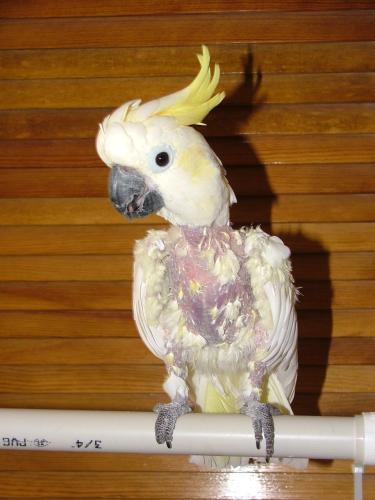 I believe I mentioned a couple of weeks ago that Peachie the Mollucan Cockatoo had laid an egg. My African Grey, Kiwi, was at the vet last week for her annual exam. I reminded Dr. Sakas that Kiwi likes to celebrate the 4th of July by laying eggs and trying to kill me. I should really post those pictures. He examined her and said that she seems to be in “early reproductive cycle”. Which sounds like “there aren’t any eggs in there right now, but she’s thinking about it”.

The Death of the Semicolon
Random articles like this one by Paul Collins in Slate are the reason I spend so much time online when I could be reading a book.
If you had asked me cold to define the purpose of the semicolon, I would have said something like:
It’s when you want to pause for more than a comma, but keep two thoughts in the same sentence. This article says:
“The 1737 guide Bibliotheca Technologica recognizes “The comma (,) which stops the voice while you tell [count] one. The Semicolon (;) pauseth while you tell two. The Colon (:) while you tell three; and then period, or full stop (.) while you tell four.” Lacking standards for how punctuation shades the meaning of sentences—and not just their oration—18th-century writers went berserk with the catchall mark.”
If you had asked me cold why the semicolon is dying, I would have said something like:
“It’s my fault. I got lazy and started using dashes all the time. And the word ‘got’.”
Collins says this:
“As Coleridge hints, semicolons hit a speed bump with Romanticism’s craze for dashes, for words that practically spasmed off the page. Take this sample from the 1814 poem The Orphans: “Dead—dead—quite dead—and pale—oh!—oh!””
I don’t know about “spasmed off the page”, but there it is.

At the Library – Paperback Surprises

 The Next Dark Age
