The Next Dark Age
We're in it Now
My Free Vacation
 I had a whole mess of United miles to burn. I used some for the plane ticket to New Orleans. Then I discovered that because I have a Mileage Plus Visa, I could use more for the hotel. I may have written that it only works for miles earned with the card and that I paid for the hotel with my card and was reimbursed by using the miles. Long story short, I didn’t pay anything for my flight or my half of the hotel bill.
So I was checking my Amex card online today. Wow, did I spend a lot of money.
Between eating out, books and gifts, the cab fare (to and from the hotel and from O’Hare to my house) and miscellaneous cash out of pocket, I spent $736.
In my brain, it costs about $1,000 for a person to go on vacation. Did I spend more than that on my last road trip – when gas was $4.00 a gallon? Not by much. This time I spent $736 after airfare and hotels. How the hell does a family of four go to Disney World every other year?!
I daresay I have done my part for the economy.
Writers’ Theatre – The Minister’s Wife

I’ll just let that one sink in for a minute.
Writers’ Theatre has done more than one “world premiere” and I generally enjoy them. It was directed by Michael Halberstam (my one true love) who has directed Candida in the past. In fact, if I understood the story from the playbill, Michael lit the fuse that launched the project in the first place.
I don’t always agree with his choices. And seriously, I didn’t even hear the second half of the first song because my eyeballs had rolled all the way to the back of my head and I was trying to shake them back into focus. But I warmed up to it.
Here is the summary from the website:
Reverend James Morell and his wife, Candida, are happily married—at least so they think. But when Eugene Marchbanks, a romantic young poet aims to rescue Candida from her domestic routine, everyone’s world is turned upside down. This world premiere musical is adapted from George Bernard Shaw’s Candida by Austin Pendleton with lyrics by Jan Tranen and music by Josh Schmidt, the highly acclaimed and award-winning composer of Adding Machine. Sharp, witty and tender, A Minister’s Wife explores the fires burning beneath the surface of an ordinary marriage and discovers a secret in the heart.
First, someone please help me with this: When I was in high school, I was taught a term for a particular literary device and I can’t remember it:
When a character is much discussed but little spoken to, when what she does means less than what she represents – it is called something. In class, we were discussing the chick in Cyrano de Bergerac. That is how Candida seems in the beginning of the story. I was all braced for just exactly how much I was going to hate this character when she finally made an appearance.
But as the play progresses and we get to know her, Candida doesn’t suck. I rather liked her. I fancy that I even understood her.
[That sound you heard was my mother fainting dead away.]
The men were the big fools. The climax of the play involves Candida’s husband and the 18-year old punk asking her to choose between them. I laughed out loud as Candida played along. That might have something to do with the actor playing the kid – he was like a big, demented Hobbit. I am pretty sure he meant to play it that way.
The actors were good all the way around. The musicians, huddled backstage, sounded great to my untrained ear. I’m just not sure this one requires singing.
In any event, here goes Writers’ Theatre again, making me go read a play to find out if I really liked it or I just liked this interpretation.

The Dogs of Babel, by Carolyn Parkhurst
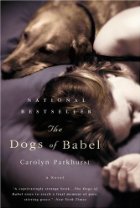
The Dogs of Babel was another book club favorite, and written by Carolyn Parkhurst, an AU alumna. I picked it up at the Library’s Used Book Sale. The premise is that a lady was found dead in her backyard having apparently fallen out of her apple tree. She was discovered by a neighbor that heard her dog barking when he arrived home from work.
The death is ruled an accident, but the husband, Paul, starts to think it might have been a suicide. He determines that the dog is the only witness and decides to teach the dog to talk.
OK – so this is a book about crazy-grief. And a dog named Lorelei.
I liked the concept, but was not half-way through before deciding that the wife was a nutjob and the husband a fool. Then I got to the part about the criminally insane people using surgical techniques to get dogs to talk. Then Lorelei disappears and I don’t care about what shocking thing might have happened in the next flashback because all I want to know is if the dog is ok.
She was. Mostly.
The conclusion was incredibly anti-climactic, but even if it weren’t, I left the book feeling utterly disgusted.
Photography in Jackson Square
I tried to keep to something resembling my average weekend schedule while on vacation, so I was pretty much up and out around 8:30. As Rich and Jodi are rather nocturnal types, I was on my own for breakfast.

So I took a couple of random pictures with my phone and then sat down to read.
2. Go all artiste and explain it to me in all sorts of detail
Coming Through Slaughter, by Michael Ondaatje
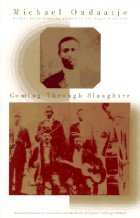
I was in the local section of a book store in the French Quarter. I should do a full post about the bookstores in the French Quarter. Michael Ondaatje is actually Canadian, and is most famous for writing The English Patient.
Coming through Slaughter is a much earlier piece. It was in the local section because it is a speculative piece of fiction regarding the mysterious life of Buddy Bolden, a rather famous musician at the turn of the century who is credited with pioneering, if not outright creating, jazz music. You know what? The book summary can do this better:
“At the turn of the century, the Storyville district of New Orleans had some 2,000 prostitutes, 70 professional gamblers and 30 piano players. It had only one man that played the cornet like Buddy Bolden. By day he cut hair and purveyed gossip at N. Joseph’s Shaving Parlor. At night he played jazz as though unleashing wild animals in a crowded room. At the age of 31, Buddy Bolden went mad.”
These appear to be the facts. Bolden was never recorded and there is only one, poor photograph existing of him. Ondaatje imagined the rest.
The other cool thing is that this piece appears to be an early attempt of a poet branching out into narrative fiction. So besides being not entirely linear, the perspective changes. There is also train of thought and script dialogue and lyrics. It is a short enough piece to pull off the effects rather well. From Bolden’s perspective:
“…me with a brain no better than their sad bodies, so sad they cannot afford to feel sorrow toward themselves, only fear. And my brain atrophied and soaked in the music I avoid, like milk travelling over the boarder into cheese.”
He was talking about the prostitutes. The end doesn’t tie things up very nicely, but that is both true to the history and true to the poetry. In the end, it just feels sad – in the “we missed out on something great” way.
Amazing What a Coat of Paint Can Do
While I was in New Orleans, we boarded Kiwi and had some painting done. I don’t mean to turn this into the Home Renovation blog, but I suspect my mother sent me all of these pictures so that she could just send my link to her friends.
I believe I mentioned that we finally dismantled the old formal dining room and made it into a bird room. Before:
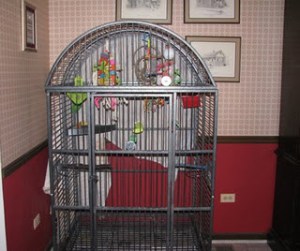
After:

And since Kay couldn’t let the red go, the kitchen went from periwinkle (with Eloise and the pizza):

to chili pepper (with Kiwi on the fridge):



Someone that is clearly not me decided that the furniture should be moved.The point is that a new paint job can do wonders for one’s perspective and I think in a cost/benefit analysis of happiness it really can’t be beat.
Liquor, by Poppy Z. Brite

I hadn’t read any of Brite’s books before, but there was an essay in one of my New Orleans books so I thought I should check her out. Liquor is the first in a series of at least three. The plot involves a pair of childhood friends – now lovers – that have an interesting concept for a restaurant. They have just been fired from a restaurant that is clearly based on Margaritaville. I am embarrassed to say that I have eaten there.
As luck would have it, they know a guy that is friendly with a guy so clearly based on Emeril that even I spotted it. The Emeril-guy goes in with them as a silent-ish partner.
So. A funny/satire/kinda suspenseful book about the New Orleans restaurant scene? I am in.
The characters didn’t suck, the plot was only half-convoluted and I was really interested in the commentary on the industry. I particularly like the contrast between cooking for the locals and cooking for the tourists – apparently the locals take issue with Emeril catering so completely to that crowd.
Hello. That’s where the money is.
I learned that the strawberry sno-cone is the official hangover treat of the gods. I learned that a new restaurant has to be tough with the vendors right from the start or they will be supplied with bad tomatoes for all eternity. I learned that some people will really try anything.
Three Roads to the Alamo, by William Davis
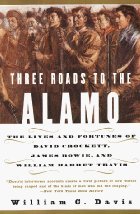
The concept of this book was to weave the personal history of the three famed heroes of the Alamo – Crockett, Bowie and Travis – from birth to the main event. There was a lot of myth-busting.
Because Travis was younger, the first third of the book bounced between Bowie and Crockett. Crockett, as we know, was a congressman. His schtick was to be the Western Everyman – very Jacksonian. Except that he was far too independent for the true Jacksonians and they managed to have him voted out of office, which is how he landed in Texas. A lot of that “I’m my own man” stuff was a bit too much for me on the heels of McCain.
Bowie was a land speculator. Perpetuated major fruad against the federal government. I felt sleazy just reading it. Went to Texas when his other deals fell through.
Travis was a young lawyer so far into debt that he fled to Texas, abandoning his wife and two young children. Nice.
Suffice it to say that the Alamo redeemed them all.
This was not my normal pick for subject matter, but I was at the Alamo in January so I gave it a try. It was well-written, but now I am done.
Voodoo Museum
I have been to New Orleans plenty of times, but this was my first visit to the Voodoo Museum, which is pretty lame of me since it is in the French Quarter and most of my excuse for not doing things is, “I didn’t set foot outside the Quarter”. But Voodoo has always scared me.
Upon entering the building, I was greeted my a very nice man with a very thick southern accent that gave me the short-short version about how voodoo came to the U.S. with the enslaved people from west Africa. Of course they weren’t allowed to practice their own religion, but they found enough similarities between voodoo and Catholicism to be able to hide it in plain site. The nice man continued on to say that voodoo traditions deal mostly with calling upon the spirits for good things like love and good luck and prosperity and it is really only Hollywood that makes it scary and evil. Then for five bucks I went back to see the artifacts. The nice man said that I could take pictures.

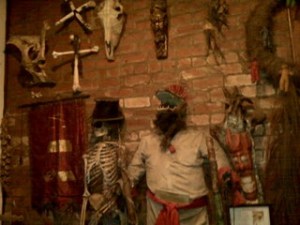
Then there was the man with the alligator head, surrounded by lots of bones:
At his feet was another alter-like display. I forgot its significance:
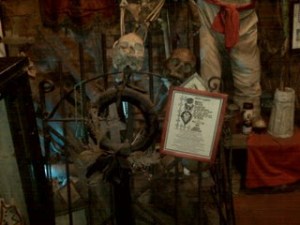
They had a wishing stump with instructions and everything. I considered using it, but you have to write your wish on a piece of paper and leave it in the stump. I can’t think of anything more embarrassing that having my wish read and mocked by a voodoo queen.
Anyway. I was all about the beauty of hiding one’s faith in the traditions (superstitions?) of Catholicism. But I don’t see why it requires so many carcasses. I didn’t even take pictures of the worst ones, but when my friend Rich tried to tell me that it all made sense because Catholicism was all about a gruesome medieval torture device, I countered that a model of a crucifix was not the same as have an actual petrified cat hanging from the wall.
On the way out, there were voodoo dolls and books. And snakeskins and chicken feet. And I saw a sign in the window that suggested the nice man that gave me the short history was also a practitioner available for consultation.
Then I got the hell out of there and went for some iced coffee.
Read Some Books, Spent Some Money, Drank a Lot of Iced Coffee

 The Next Dark Age