The Next Dark Age
We're in it Now
Pleasant Surprises
The other night my mechanic called. Left a message to call him back.
What? I am at least a month from my next oil change and there were no pending things with my car – as far as I knew. I called him right back. He said that I won the raffle he ran last month for Dinner for Two and that I should come by and pick up my prize.
While running my about-to-leave town errands, I stopped at the shop. He said, “Do you mind if I just write you a check? That way I don’t have to guess about where you like to go and you can do whatever you’d like.”
It occurred to me to suggest that he just put a credit on my account (and I don’t mean that sarcastically), but that didn’t seem in the spirit. Or even polite. I told him I was happy either way.
We were talking as he was writing, so I didn’t look at the check as he handed it to me. I figured it would be 40 or 50 dollars and went to the bank to cash it for travel money. It was $100!
Clearly I do not have gourmet tastes.
Inauguration Day
Washingtonpost.com reported that the bridges into and out of Washington DC are going to be closed to traffic on Inauguration Day.
Rumor has it that if the expected crowd shows up, there will be one toilet for every 6,000 people in town.
Yesterday, my travel agent told me that Washington is so out of hotel rooms, that Amtrak is going to park its train in Union Station, rent out the sleeping cars and keep the dining cars open.
Supposedly, every business that is not in hospitality (or profits from it) is going to be closed.
You couldn’t pay me to attend that event. I shall be perfectly happy huddling in the lunchroom and watching it on TV with my co-workers.
Conventions and Meetings
I am leaving tomorrow for our big annual meeting. This is my 12th year working this event. That number pretty much puts me at the grown ups table.
“What was your first Annual Meeting?” is a common question among our veterans.
I remember the question being posed to my friend Jeff in IT. “Charlotte” was his answer. I narrowed my eyes and looked at him. Then figured it out:
“Oh, you must mean Charlotte 2. Charlotte 1 was my first Meeting.” And I realized that I sound like one of those people. That require the acknowledgement of seven additional years of meetings for the maintenance of my own self-worth.
I have noticed that at some point, these meetings that only happen for one week out of the year, start to run together. And the old people will sit around and say something like, “I remember a really great steakhouse in the Hilton. That had to have been in Houston. No, it was Albuquerque. What year was that?”
And I have joined them. Here are a few more:
“That was the year the lady fell down the escalator and had to go to the ER. We learned a lot about ‘traffic control’ that night.”
“No, I don’t remember the keynote speaker, but I remember the prostitutes sneaking into the Convention Center. Marsha figured out they were wearing fake badges and threw them out herself!”
“Brad was coordinating security, but he had a family emergency. We asked Cody to step in and his first question was, ‘Do I get to carry a gun?’”
“So Don dragged us 10 blocks out of our way because he had to have a ‘Mothers sandwich’. Swore it was the best lunch in New Orleans, as we stood outside this dive, waiting in line. Dude was right!”
Not long ago my friend Rolland (whose first Meeting was when I was in Kindergarten) and I noted that some of the stories have become legend. In the “I’m not sure which part is actually true” way.
Getting a good story out of it is the entire point, I think. Except now that I have stories, what I really want is no surprises at all. And that’s how I really know I am getting old.
70 is the New 50
MSNBC reported another bleak retail story that I remember hearing on the news recently. It seems that back in the day, “50% off” was when we all thought we were finding a really good deal. Apparently, that number is now 70 or 75%.
What I learned is that stores order merchandise four to seven months in advance. So the September meltdown (should that be in quotes? Or at least capitalized? I think it is an official title now.) came too late for retailers to adjust.
But the story is that spring also looks bleak, in part because we are all expecting great deals to continue. If you accept that many things involving money (and most everything about the spending of it) are emotional rather than logical, you will believe the expert:
“It will be years before shoppers are going to be enticed by discounts of less than 50 percent”, said C. Britt Beemer, chairman of America’s Research Group.
I am not a serious bargain hunter. Compared with Thrifty Chicks, I am a rank amateur. With clothes, where I only wear one color, I am willing to pay more for something I really like. And since the shoe industry has figured out that not so many ladies wear a size 6 these days, I am often out of luck there, too. Clothes and shoes are not things I buy second hand. However. There are several stores where I won’t even walk in the door without an extra discount of some kind. That was true before the Meltdown. I have been mentally programmed that finding deals is good. And fun – like a game.
What I really need to do is reprogram so that I don’t start shopping in the first place.
What I have been hoping is that this is not a market crash phenomenon, but Americans coming to the conclusion that we don’t need everything that we want. And that financial independence feels better than shopping.
I’m not even there myself.

My Secret Life on the McJob, by Jerry Freeman
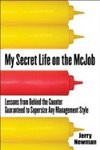
I read My Secret Life on the McJob, by SUNY management professor Jerry Freeman. His sabbatical project was to work around the country at different fast food restaurants and observe the management techniques. This book is the final product.
The interesting conclusion he came to was that the procedures for making sandwiches are extremely rigid, but the management of people was entirely up to the location.
An observation he made is that those procedures are made so that people don’t need to think, they simply react. This may be helpful during the lunch rush, but the consequence is that since crew members are not required to think, managers tend to think they are not able to think for themselves.
There was discussion of turnover, which I found interesting. He noted that most of us white collar HR types would panic at the sight of a 25% turnover. True. In fast food the standard is between 200 and 250%. The manager that Freeman called the “best” was extremely proud of her turnover rate – 111%.
I liked that Freeman made a point to say that his favorite manager – the most personable and caring – was not quite the “best”. The “best” had high expectations for performance and played by the book, which was not always accommodating.
He discussed the use of “more hours” as a reward for good work. In fast food, financial rewards are not easy to come by, and promotions can only go a couple of grades before someone has to retire for the next one. Hours are reduced for employees not measuring up.
Socio-economic point. Freeman noted that one fast food place was paying a much lower hourly rate than a competitor store a mile down the road. Why would anyone work for a dollar less per hour? Because not everyone has the transportation to get himself down the road reliably.
The chapter on Diversity was great. Freeman notes that fast food is the best integrated industry around. No one cares about gender or religion or ethnicity if the job is done. However. He noted that women are generally at the register (because they are more friendly and approachable or something) and are never asked to help unload a truck. Also (I wish I had the book handy to quote it), he made a point about “critical mass”:
When you have a diverse group, people work together and get along out of necessity. Everyone needs each other to get the job done well. When the job is done well, you start to like each other. However, at the “critical mass”, whatever the number may be, people don’t need to work en masse and will congregate with their “own” group.
Is that a universal truth? Maybe that is Freeman’s next book.
"Mandatory Volunteering"
Someone was blogging about someone blogging about the concept of “mandatory volunteering”. I think the original post linked to a London Times columnist talking about how the government (British) should require everyone between the ages of 12 and 85 to perform 12 days of “volunteering” each year.
A different link went to an interesting L.A. Times article. Columnist Jonah Goldberg started by noting (back in July) Barack Obama said in a campaign speech that as president he would:
“set a goal for all American middle and high school students to perform 50 hours of service a year, and for all college students to perform 100 hours of service a year.”
He then cited the following:
“Americans are vastly more generous with their time and their money than Europeans. According to social demographer Arthur C. Brooks, in 1995 (the last year international comparative data on giving was available), Americans gave 3 1/2 times as much money to charities and causes as the French, seven times more than the Germans and 14 times more than the Italians.In 1998, Americans also volunteered 21% more than the Swiss and 32% more than Germans — two countries with compulsory national service. And yet we’re continually told we should emulate them so that America too can have a “culture of service.””
His point was that if the government starts to make these things mandatory, the government will mess it up. Not to mention spending a fortune on the bureaucracy to enforce it. Or else require schools to enforce it, as if they don’t have enough to do. And any way, college kids?
I’m not saying that I didn’t personally have the time. I had the time and wasted it like many kids away from home for the first time. But my roommate was an athlete. There were plenty of students like her that did not have scholarships, but participated in other activities. It required careful scheduling. Plenty of kids are required to work part-time (full-time in the summer) just to meet their expenses. Some even do both jobs and activities. A hundred hours of community service on top of that? I don’t think so.
Goldberg, and a whole lot of British Internet commenters, likened “mandatory volunteering” with slavery. I wouldn’t go that far. But I do think that unwilling “volunteers” are more trouble than they are worth for an organization. And besides, it would suck all of the joy out of it.
You can read the L.A. Times article here.

Target Markets
MSN has a link that says, “11 Reasons to Save Detoit”. I think it is going to be a socio-economic argument in favor of the bailout, with statistics on how many people they employ and how many suppliers they offer business. So I click.
No. It is talking about the “terrific cars”.
I drive a Saturn. You don’t have to talk me into American manufacturers. But I don’t need to hear about how the $100,000 Corvette ZR1 can go 205 miles an hour, “sleek as a gazelle”.
Clearly, I am not the target audience.

Lovely Green Eyes, by Arnost Lustig

My freshman year in college, I took a survey course in Cinema. The professor was Arnost Lustig, a Holocaust survivor from Prague. He was sent to the camps at age 16 – Auschwitz and then Buchenwald. If I remember the story correctly, he escaped with a guy he knew during transport to another location. We read one of his books that semester, and I have read a couple since then.
He made a big impression on me. I remember that semester he was gone for a week while he participated in a group that went back to Auschwitz to gather artifacts for the Holocaust Museum in Washington. The last time I Googled his name, he had retired and returned to Prague. God Bless.
Lovely Green Eyes was written in 2000, after I graduated. It popped up at the Library Used Book Store last month and I jumped on it.
The main character is a 15-year old Jewish girl who managed to get out of Auschwitz by pretending to be an Aryan, lying about her age and getting assigned to a brothel that served army soldiers. The first person narrative is actually told post-war by her husband. “Lovely Green Eyes” is her nickname at the brothel. “Skinny” is her nickname after the War.
There are several stories told here, going back and forth in the chronology between the War and the year or so after it ended. Two pieces stood out: the seriously deranged German officer, whose story is too violently ugly for me to revisit, and the rabbi who went into hiding and later found that his wife and daughter died in the camps.
Lustig’s books rely heavily on the theme of survival, but this one shifted the focus a bit to Survivor’s Guilt. Or rather, Survivor’s Guilt as a piece of Post Traumatic Stress Disorder. An interesting scene was Skinny arriving back in her old neighborhood to see how it hadn’t changed.
Lustig’s language and style makes an easier read than you would think of the subject matter. Interestingly, while he was a literature professor at The American University, he writes in his native Czech and then has someone else translate them into English.
I should Google him again and find out if he is still writing.
It Has Come to This

This, Ladies and Gentlemen, is a charger station. I had so many cords and plugging and unplugging and the Blackberry can’t last the weekend without some juice so I picked this up at Bed Bath & Beyond.
Pictured are the Kindle my brother gave me for Christmas, my iPod, my work Blackberry and then my personal cell phone down in front. That I haven’t turned on in months.
The store had three models. I picked the mid-range one that included a power strip. I actually had to swap out powerstrips because the cord on this one didn’t reach down to my outlet.
I was hoping for some extra space to store batteries and thing. The little drawer barely holds my spare cords, let alone anything for my camera:
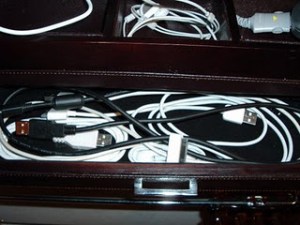
This was #2 on the List of things I must buy to keep up with the gadgets my family buys me. #1 is an external hard drive, which I haven’t bought yet. When my mother gave me the big iPod I determined that it was time to put the entire music collection down and back it up. As opposed to the 3 gigs I have on the old Nano. But the task seems overwhelming right now.
I want it noted for the record that I am doing my part for the economy.
And Then There Were None – Agatha Christie
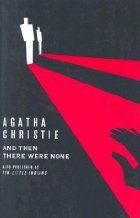
I mentioned that I first read And Then There Were None, by Agatha Christie, in high school. It was assigned reading to my freshman English class. I wasn’t a mystery reader, so I skipped to the end the first time I had a guess and was totally astonished by Whodunnit.
I had picked up a lovely copy at least a year ago at one used book store or another. Because it was a re-read, it sat on the bookcase until I started playing the computer game. I read behind the game so as not to spoil anything.
What struck me this time around was how often this premise is used in popular culture. The horror film genre depends on one person dying at a time, and no one quite knows why until the end. But horror films generally don’t have the “one of us did it” element. But Remington Steele sure did.
I forget who made the observation, but I think it was online. Every once in awhile, when watching a classic film for the first time, one might find yourself thinking, “So that’s where the Simpsons got it!” That is a really good reason to read this book.
Also, there is the study of how people behave as fear starts to take over. Distrust, paranoia, hysteria. How they turn on each other.
There is a reason why this is “the bestselling mystery novel of all time”.
 The Next Dark Age
